
Create a Lead Magnet: E-books, White Papers, and Checklists as Freebies
A lead magnet is the most powerful tool in digital marketing for turning anonymous visitors into concrete leads. By offering a high-quality e-book, a well-researched white paper, or a practical checklist, you provide users with real value—and in return, you get their email address to build a long-term customer relationship. Here, you’ll learn which types of lead magnets work, how to structure a 10-page e-book, and how to optimize the download page for maximum conversion.
What is a lead magnet, and why does every business need one?
A lead magnet is a free offer that prospects receive in exchange for their contact information. It serves as the gateway to funnel marketing and is the first step in a systematic welcome series. Without a lead magnet, the majority of visitors leave a website without ever returning—but a good freebie is the start of a scalable relationship.
A lead magnet only converts if it solves a specific problem in less than 10 minutes—not if it’s just trying to impress.
The basic formula: Problem → Solution → Transformation
The biggest mistake people make when creating lead magnets is taking too general an approach. A “Guide to Successful Marketing” won’t attract anyone. “10 Email Subject Lines That Achieve a 40% Higher Open Rate” will. The more specific the promised result, the higher the conversion rate on the download page.
- Definethe target audience precisely (occupational group, experience level, specific problem)
- Promise a single, measurable benefit
- Make it easy to consume right away (max. 15–20 minutes reading time)
- Professional Design — Has a Direct Impact on Perceived Quality
- Formulate titles using a number or a specific result
A Comparison of the 7 Best Types of Lead Magnets
Not every type of lead magnet is suitable for every target audience. The following table shows which lead magnet is appropriate in which situations and how much effort is required to create it. Content marketing and B2B environments have different priorities than e-commerce or social media.
| Lead Magnet Type | Development Effort | Conversion Potential | Suitability |
|---|---|---|---|
| E-book (10–20 pages) | High (8–15 h) | High | B2B, Coaching, Consulting |
| Checklist (1–2 pages) | Low (1–3 hours) | Very high | All Industries |
| White Paper (15–30 pages) | Very high (20–40 h) | Medium–high | B2B, Enterprise, SaaS |
| Template / Template | Moderate (3–6 hours) | Very high | Marketing, HR, Finance |
| Mini-Course (3–5 videos) | Very high (15–30 h) | Very high | Coaching, Online Courses |
| Swipe File / Collection of Examples | Moderate (2–5 hours) | High | Copywriter, Designer, Social Media |
| Calculation Tool / Calculator | Medium–high (5–10 h) | High | Finance, Real Estate, SaaS |
Checklist: What Makes a Good Lead Magnet?
Before you start creating it, evaluate your lead magnet based on these criteria. If it meets all of them, it will typically achieve an opt-in rate of 20–40% on the landing page.
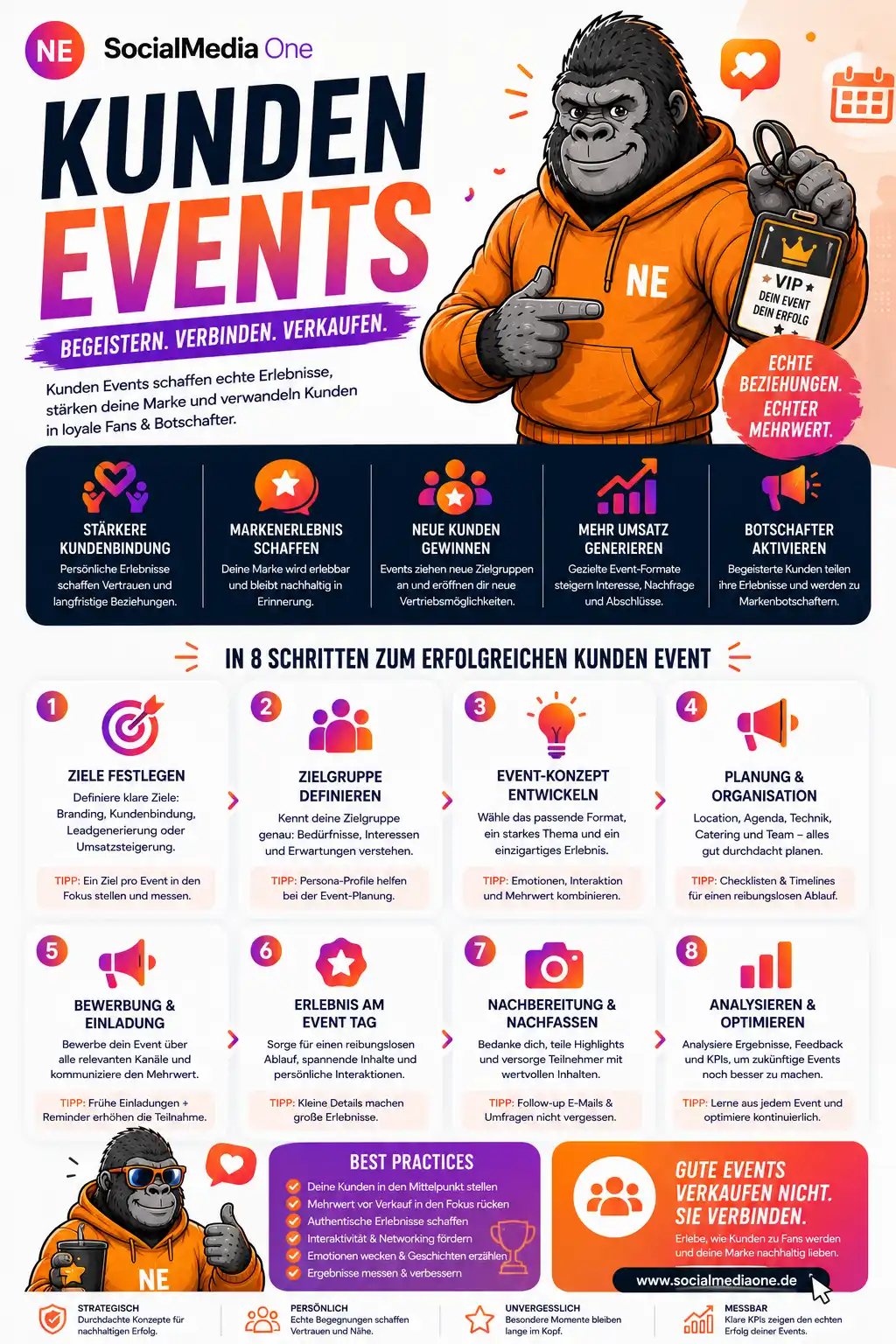
Webinars are one of the most effective B2B lead-generation formats—this infographic shows how online events are promoted via social media and converted into leads.
- Solves a specific, urgent problem faced by the target audience
- Promises a specific, measurable result in the title
- Can be consumed in less than 20 minutes
- Contains at least one actionable step or a template
- Features a professional layout with a logo and branding
- Includes a clear next step (call to action at the end)
Available for direct download or access as a PDF, video, or tool
- Thematically aligns with the subsequent welcome email series
Mini-Guide: Structure of a 10-page E-Book
A 10-page e-book is the ideal place to start—long enough to provide real value, short enough to actually be read. The following structure has proven effective in practice and can be used in any industry.
Pages 1–2: Cover and Introduction
- Cover: Title, subtitle, logo, appealing design
- Introduction: Identify the problem, engage the reader, and make a promise
Brief introduction to the author / brand (3–4 sentences)
Pages 3–7: Main content in 3–5 chapters
- Each chapter solves part of the problem
- Include specific examples, screenshots, or figures
- Short paragraphs, bullet points, visual breaks
- At least one template or checklist as a usable element
Pages 8–9: Summary and Next Steps
- Summarize the key findings in 5–7 points
- Recommend a clear next step (e.g., schedule a consultation)
- Link to additional resources on your own website
Page 10: Call to Action
- Specific Offer: Course, Consulting, Tool Demo, Next Resource
- Contact Information and Social Media Links
- Reference to the welcome email series (“Check your inbox”)
Lead Magnets and Email Funnels: How They Work Together
The lead magnet isn’t an end in itself—it’s the starting point for an automated email marketing sequence. Anyone who ignores this connection is wasting 80% of its potential. The welcome series, which starts immediately after the download, determines whether a lead will become a buyer.
Recommended Welcome Series (5 emails)
- Email 1 (immediately): Download link + brief personal greeting
Email 2 (Day 2)
Top tip from the e-book, with a concrete real-world example
Email 3 (Day 4)
Most Common Mistake in This Topic + Solution
Email 4 (Day 6)
Case Study or Customer Success Story
Email 5 (Day 8)
A specific offer with a clear call to action (consultation, product, course)
Important: Every email must stand on its own and provide value—even if the recipient never makes a purchase. If you generate leads and then try to sell to them right away, you’ll lose the trust that the lead magnet has built up.
Conversion Optimization for the Download Page
A high opt-in rate doesn’t happen by chance. The landing page for the lead magnet follows a clear structure designed to optimize conversions. Key elements:
- Headline with a specific value proposition (not a generic title)
3–5 bullet points
What the reader will know/be able to do after downloading
Visual mockup of the e-book / checklist (increases conversion by 15–30%)
- Opt-in form with a maximum of 2 fields (name + email)
- Privacy notice directly below the button
- Social Proof: Number of downloads, ratings, well-known logos
No navigation menu
The site has only one goal
That sums up the main point:
Every additional form field reduces the conversion rate by an average of 11%. Less is more.
Lead Magnets in a B2B Context
In the B2B sector, white papers and studies are particularly effective because decision-makers are looking for more in-depth information. Anyone implementing a B2B social media strategy should promote lead magnets on LinkedIn and Xing —the platforms where professional audiences are active. LinkedIn content, in particular, when combined with a targeted lead magnet, generates high-quality leads who are actually ready to buy.
Lead magnets are well-suited for performance marketing as an offer in paid campaigns—especially for Lead Ads on Meta and LinkedIn, where the form is filled out directly within the platform without the user having to leave the page.
Conclusion
A well-designed lead magnet is one of the most valuable assets in digital marketing. Whether it’s an e-book, checklist, white paper, or template—what matters isn’t the format, but the specificity of the benefit and the quality of the execution. If you combine the lead magnet with a well-designed welcome series and a conversion-optimized download page, you’ll create a system that continuously generates qualified leads. Start with the type that promises the least effort while offering the highest relevance to your target audience—a well-crafted checklist beats a mediocre e-book every time.

How-To Content: Using Tutorials, Guides, and Search Intent Effectively

More B2B Sales: Leads, LinkedIn, and Sales Strategy

History of Marketing: From Early Advertising to Modern Campaigns
More Sales: Leverage and Key Metrics for Increased Revenue

How to Attract Customers for Free: 10 Methods That Really Work
More Downloads for Your App: 15 Strategies for ASO, Paid, and Organic














 4.9 / 5.0