
Email funnel: Automation with sales funnel

E-Mail Sales Boost Automation with Sales Funnel! Re-engage customers, win new customers.
Email funnel: Automation with sales funnel
Email funnel – A sales funnel, or more precisely an email marketing funnel, increases company sales to a whole new level. Quickly explained: email funnels are optimized sales funnels into which leads (qualified traffic, e.g. via social ads or Google ads) are introduced. Sometimes the sales even exceed our customers’ expectations. You can see what this means in the infographic. What is an email funnel? How does a funnel work? How do you create a successful funnel?
Questions? Talk to us or write to our sales funnel experts: Contact
Your agency for email marketing and automation 2026:
- Full-service e-mail marketing agency
- Creation, merchandise management to payment providers
- Scaling: Targeted reach through advertisements
- Experts for Social Ads / Google Ads and Native Ads
- Targeting: Addressing by age, interests, etc.
- Re-targeting: Re-addressing, e.g. e-commerce
- Leads: email funnel and email marketing
- Monitoring and optimization of all KPIs
- Performance marketing methodology
- Experience from many cases
- Contact person: Contact

Stephan M. Czaja, owner
CXMXO Group
Email funnel marketing: quickly explained – 3 facts
Let’s first clarify all the important terms and 3 questions.
What is an email funnel?
What is a funnel? As described in the introduction: Email funnels are optimized “sales funnels” into which leads (i.e. qualified traffic, e.g. via social ads or Google Ads) are introduced. Leads can be collected from various sources:
- Internal, for example own website
- External, leads from third parties (such as affiliate partners)
A typical lead leaves their data: Name and e-mail address. The less data that has to be entered, the better (simpler, faster for the user). For this purpose, landing pages are built, for example, that specifically encourage the user to “sign up”. For example, with a small gift, such as a free e-book on topic X (to be seen later in the “pop-up example”).
Pop-ups are another popular tool. These are small windows that open above the actual browser and briefly block the content. The user has to deal with the pop-up: He or she can only 1) sign in or 2) close the pop-up.
How does a funnel work?
As soon as users have registered in your e-mail funnel, the “machine” starts.
- Double opt-in -> data protection compliant
- Survey -> Segmentation
- Start -> Automated e-mails
- Personalization -> Tracking and analysis
More on all these points later.
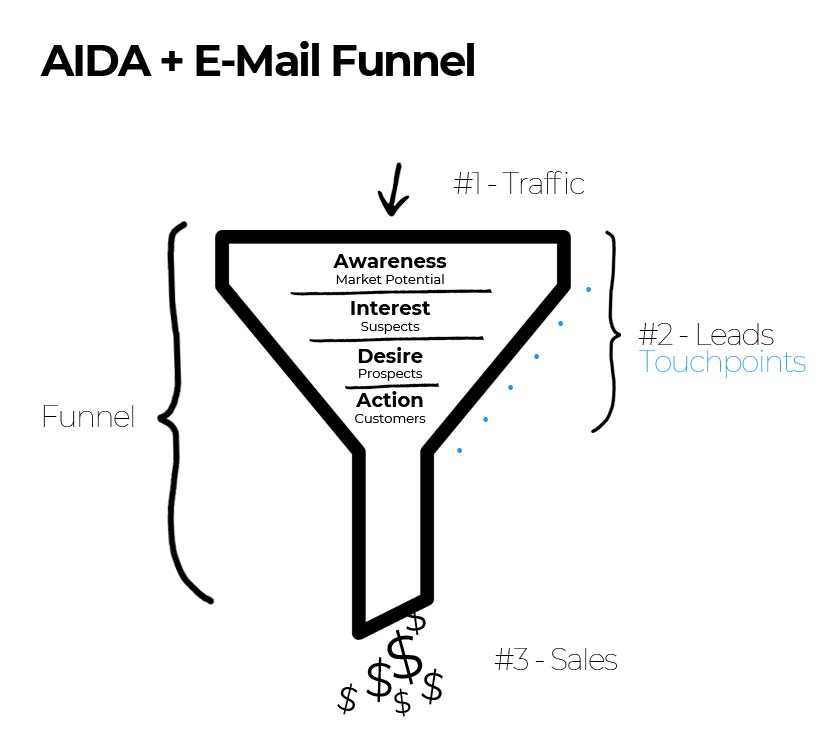
This “path” is technically known as the customer journey. So to speak, from the ad on Google, via the landing page, into the email funnel, through automation, to the sale. This means that email funnels also follow the “classic” four-stage customer life cycle:
- Interaction
- Discovery
- Purchase
- Binding
How do you turn leads into customers? One method is based on the AIDA model, which goes from 1) attention to 2) interest. Then 3) the interest is aroused, the desire is awakened and the lead 4) completes the transaction and / or purchase.
The next step involves up-sells and cross-sells (more on this later).
How do you create a successful funnel?
In the following, we show why the creation and optimization of an email funnel should ideally be managed by an experienced agency. It is 1) about experience from practical customer projects and 2) about constant optimization through innovations, but also through results from reporting and analyses.
5 advantages of email marketing
Many people think email marketing is so 1990.
The fact is, however, that email marketing and funnels in particular still deliver extremely good performance figures. Why is that?
Firstly, email marketing is automated, so you don’t have to deal with each “customer individually”. Through segmentation, i.e. division into groups, for example through a small, initial survey at the beginning, emails can be made even more relevant (content suitable for the target group).
Through clicks, tracking and analyses, the emails become more and more personalized, also through sales (as can be seen in the infographic above). If user X has bought product X, he or she will take a different route from now on and receive customized, personalized emails. These are usually sent directly to the smartphone, directly to the workplace. This is what makes emails so immediate.
Ultimately, all of this ensures that the ROI (return on investment) for email funnel marketing is so high. As I said, sometimes even higher than our customers expect.
Let’s summarize the 5 advantages once again:
- Automated: E-mail marketing
- Relevant: Segmentation
- Personal: Personalization
- Directly: Newsletters are direct
- Particularly high ROI
Infographic: Email automation
This is how a funnel works:
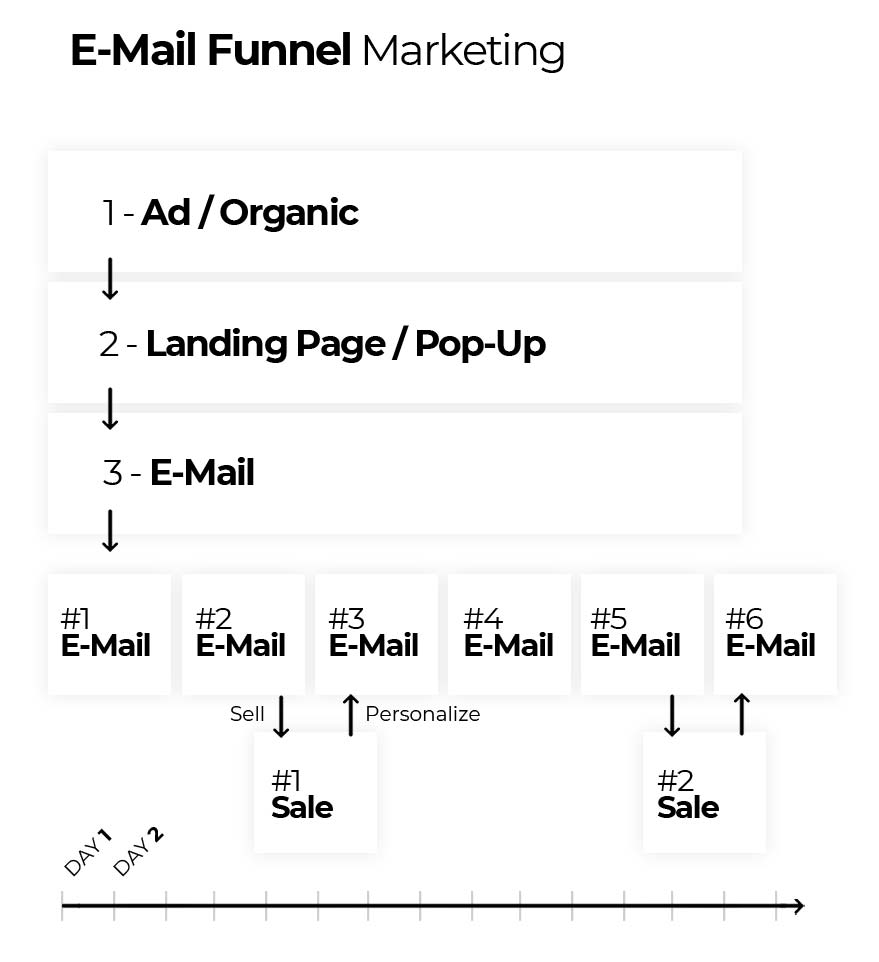
Collect leads: Landing page and pop-up
There are two effective ways to collect email addresses. The aim is always for users to register in the opt-in form.
- Landing pages
- Pop-ups
Landing pages are small, extra subpages of a website that are built specifically for the purpose of getting visitors to sign up to the opt-in form and become leads. The content is specially adapted for this purpose, everything is focused on the form, the benefits and there is often a free gift. This increases the rate of registrations even further. Sometimes main menus and other elements are also omitted. The fewer opportunities for promotion, the greater the focus on the desired action -> signing up in the email funnel.
Pop-ups are not individual subpages, but content that is superimposed on the actual website. This blocks users from the content and they have to engage with the content. They either sign in or close the pop-up.
Pop-ups example with gift:
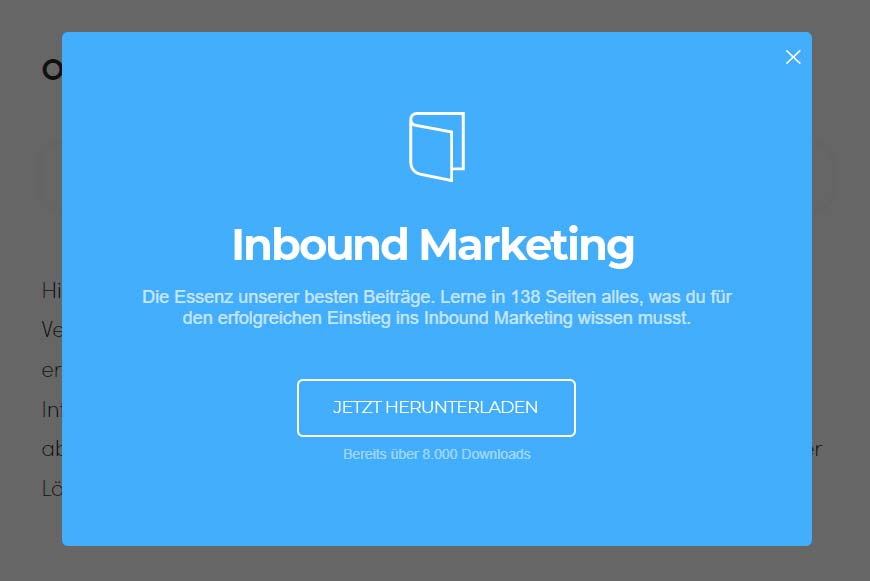
Different designs, texts and colors can also be tested here. This allows you to see later in the analyses what brings many leads and what brings fewer.
A practical example, here even the book covers (download for opt-in) were designed differently in a quick test.

AIDA: From attention to purchase
As always in marketing, there are very basic strategies that are also used here in email marketing. For example, the AIDA principle.
Attention
Attention means that the user gets to know a product or a solution.
Interest
Interest means that he or she is interested in the product or solution.
Desire (need)
Need means that he or she is convinced and wants your product or solution.
Action (plot)
Action means that the customer then buys the product or solution.
Automation: Automated emails for target groups
One of the magic words in online marketing is “automation”.
The more processes are automated, the less work remains. Projects can also be scaled more easily, as you need fewer staff despite an increase in customers. Some areas and digital products or even online coaching can be extremely scalable in this way.
Email funnels can be tailored to different segments. Let’s take a look at 3 overarching target groups:
- E-mail funnel for interested parties
- Email funnel for new customers
- Email funnel for reactivation
For example:
E-mail funnel for interested parties
The typical visitor who is led from interest to the offer. A simple, effective process looks like this:
- Encourage interested parties to register (opt-in)
- Automated e-mail greeting
- Optional: Initial segmentation through a small survey
- First trigger emails with enticing offers (vouchers) directly after welcome
Email funnel for new customers
Not only new visitors are suitable as leads for your email funnel. You can also integrate your online store customers into an email funnel and turn them into regular customers who will order from you a second, third and fourth time.
Example funnel for new customers:
- Thank you email with discount code for #2 purchase
- Order e-mail with shipping status
- Multi-level campaign emails
- Cross-selling offers
- Up-selling offers
- Seasonal and themed mailings for events
- Summer season or soccer World Cup
- Days like Christmas or Valentine’s Day
- Post-purchase evaluation and satisfaction survey
Email funnel for reactivation
Every customer that does not have to be acquired anew saves effort, time and money. That’s why it’s also worth thinking about email funnels that bring customers back. For example, if they haven’t bought anything for a while.
Example funnel to win back customers:
- Reactivation e-mail with special offers
- E-mail as a reminder
- If discount code not used
- If purchase canceled in shopping cart
- Survey to improve the service: What would you like to see?
As learned in the benefits, almost all emails reach users directly, for example on their smartphone.

Case study and best practice
Case studies say more than 1,000 words! Here you will find a few selected customer projects:
Do you have any questions? We are happy to help you in a friendly and direct way!
Email marketing agency
Your agency for email marketing and automation 2026:
- Full-service e-mail marketing agency
- Creation, merchandise management to payment providers
- Scaling: Targeted reach through advertisements
- Experts for Social Ads / Google Ads and Native Ads
- Targeting: Addressing by age, interests, etc.
- Re-targeting: Re-addressing, e.g. e-commerce
- Leads: email funnel and email marketing
- Monitoring and optimization of all KPIs
- Performance marketing methodology
- Experience from many cases
- Contact person: Contact
If you have any questions, please give us a call!
More Sales: Leverage and Key Metrics for Increased Revenue

Owned Media: Build Your Own Channels and Use Them as Brand Assets

Generating Leads Through Social Media: A Strategy for Getting More Inquiries
Generating Leads Through Social Media: A Strategy for Getting More Inquiries
Lead Generation Through Social Media: Strategies for Increasing Inquiries
Generating Leads Through Social Media: A Strategy for Getting More Inquiries












Partner


 4.9 / 5.0
average of the last 12 months. Survey after consultation – online, by telephone or on site.