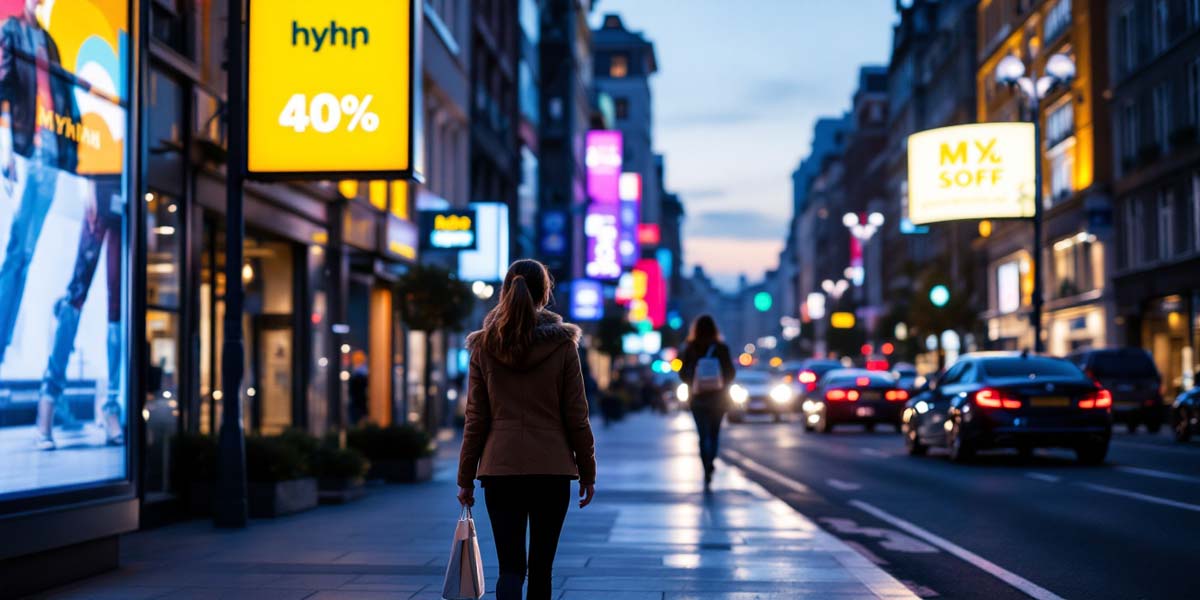
Urbanization: Its Impact on Marketing and Consumer Behavior
Urbanization describes the ongoing shift of the population from rural areas to cities and metropolitan areas. This trend is relevant to marketing because urbanization brings about noticeable changes in consumer behavior, the accessibility of target audiences, and media usage. Experimental city marketing also specifically capitalizes on this development to make brands visible directly within everyday urban life.
How Urbanization Is Changing Consumer Behavior
On average, urban households shop more frequently but in smaller quantities because living space is limited and the nearest store is usually within walking distance. At the same time, people in cities are increasingly willing to pay a premium for conveniences such as delivery services or short travel distances.
Practical tip: For urban-based target groups, consider whether smaller package sizes, express delivery, or pickup locations are a better fit for their actual lifestyles than traditional bulk packaging.
Anyone who ignores these differences and targets both rural and urban audiences with identical offerings is squandering potential in precisely those markets where purchasing power per unit area is highest.
- Smaller packages for urban households
- Willingness to Pay More for Convenience
- Walking Distance as a Selling Point
Reaching Target Audiences in Densely Populated Areas
In cities, the target audience can often be segmented more precisely by neighborhood, lifestyle, and mobility patterns than in rural areas, where greater distances necessitate a broader approach anyway. Local campaigns can be tailored on a very granular level here—for example, to individual neighborhoods or even specific streets.
- More Detailed Segmentation by Neighborhood
- Tailor campaigns to specific neighborhoods
- Incorporate mobility patterns into the message


Local Marketing as a Response to Urbanization
The more densely competitors are concentrated in city centers, the more important local visibility becomes. Geofilters and location-based advertising leverage this very effect by targeting users in the immediate vicinity of a business’s location. Even smaller businesses benefit from this, as our article on ultra-local marketing for restaurants and small businesses demonstrates.
- Using Location-Based Advertising Effectively
- Increase visibility in the immediate surroundings
- Small businesses also benefit locally
Urbanization and Brick-and-Mortar Retail
For retail chains, urbanization is fundamentally changing the logic behind store location: Instead of large spaces on the outskirts of cities, smaller, easily accessible stores in city centers are gaining in importance. How retail marketing adapts to this changed logic of store location is increasingly determining success in brick-and-mortar retail. Those who monitor urbanization trends in their own region can adjust their location decisions accordingly at an early stage.
- Smaller areas in city centers
- Adapt Location Logic to Urbanization
- Monitor Regional Development Early On
Global Urbanization and Regional Differences
The degree of urbanization varies significantly around the world, which has direct implications for how internationally active brands approach the market. In highly urbanized markets, digital and local outreach dominate, while in rural regions, traditional mass media often continue to play a greater role. Anyone planning campaigns across multiple countries should factor in the respective levels of urbanization early on in the media planning process, rather than simply applying a uniform concept without modification. Even within a single country, this consideration is worthwhile, because metropolitan areas and rural regions rarely respond to the same campaign in the same way.
- The degree of urbanization varies greatly from country to country
- Digital Engagement in Urban Markets
- Adapt Media Planning to the Regional Structure
Urbanization and the Future of Retail
As urbanization progresses, the role of traditional retail is also undergoing a fundamental shift, as more and more customers prefer short travel distances and quick availability over a wide selection. As a result, smaller, specialized retail formats in city centers are gaining importance, while large-scale retail concepts on the outskirts of cities are coming under increasing pressure. Those who invest early in more compact formats will be better positioned to serve a target audience that is increasingly living and shopping in urban areas.
- Short distances are more important than a wide selection
- Compact formats are gaining in importance
- Investing early pays off
Urbanization and Choosing the Right Advertising Channels
In highly urbanized regions, it is not only consumer behavior that is changing, but also media usage itself: Urban target audiences spend more time on their smartphones while on the go, while traditional high-reach media such as advertising papers are losing their impact. Thorough market research usually clearly shows which channels in a specific urban region still actually generate reach and which merely result in wasted coverage.
Online retail is also gaining importance in densely populated areas because short delivery routes and high order volumes make it particularly cost-effective there. Anyone planning an e-commerce strategy for urban metropolitan areas should factor in delivery times and same-day options from the very beginning, rather than adding them as an afterthought.
- Mobile Media Use Is on the Rise in Cities
- Classified ad papers are losing their impact
- Short shipping distances benefit online retail
- Plan for Same-Day Options Early
Common Mistakes When Reaching Out to Urban Audiences
A common misconception is the assumption that urban target groups are automatically more homogeneous than rural ones simply because they live in closer proximity to one another. In fact, individual city neighborhoods often differ more from one another than entire counties do, which is why blanket metropolitan campaigns frequently fail to reflect the reality of individual neighborhoods.
It is equally risky to view urbanization solely as an opportunity for growth without taking into account the increasing level of competition: In sought-after downtown locations, significantly more providers are vying for the same attention, which makes a clear brand strategy even more important in an urban setting than elsewhere.
- Do not view urban target groups as a homogeneous group
- Examining Individual Neighborhoods One by One
- Plan for High Levels of Competition in Downtown Locations
- A Clear Brand Strategy to Counter Competitive Pressure



















 4.9 / 5.0